



Gastro-Jejunal (GJ) Tubes
A gastro-jejunal tube (GJ Tube) is a tube that goes through the skin and muscle into the stomach and then into the small intestine (jejunum). There is access to the stomach and jejunum with a GJ Tube. The opening in the skin can be called a stoma, a site, or a tract. The tube is used for nutrition, fluids, decompression, or medicine.
The GJ Tube is used to feed someone who is unable to eat by mouth. GJ Tube feeding is most often needed for people who cannot absorb enough nutrients from food through their stomach or if they are having problems with their G Tube. This allows the nutrition to go right into the small intestines.
Some people cannot tolerate having food or liquids in their stomach. This is sometimes due to “reflux.” Reflux is where the contents of the stomach travel back up the food pipe (esophagus) and can make you vomit. If this happens there is a risk that the feeding can be inhaled into the lungs, which can cause a lung infection. Using a GJ Tube can stop this from happening by bypassing the mouth, food pipe, and stomach, taking the feeding right into the jejunum.
Your healthcare team will tell you the reason for needing a feeding tube.

What does a GJ-Tube Look Like?
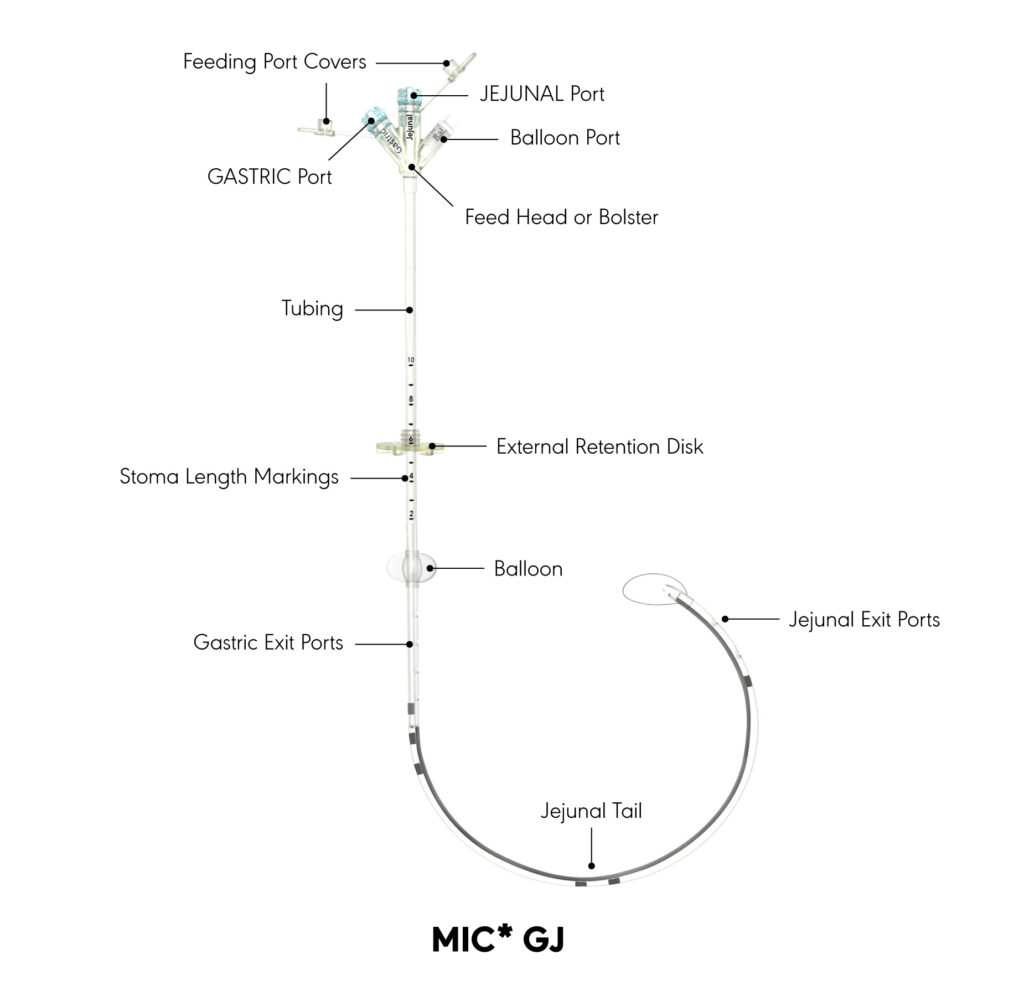

What types of GJ Tubes are there?
There are 2 types of GJ Tubes:

Standard-length tube
This is sometimes called a “dangler” because it hangs out of skin near the stomach. There is a small plastic disc which sits close to the skin and helps keep the tube in place.

Low-profile tube
This type of tube is often called a “button”. The low-profile tube is short and measured to sit close to the skin, making it less visible than standard-length tubes. Most of the tube will be inside the body and cannot be seen.
The GJ Tube looks like a G Tube, but it is made up of two tubes. One tube is inside another tube. The first part of the tube goes to the stomach and is called the gastric part of the tube. Holes in the gastric part of the tube allow medicine, decompression, or feeding into the stomach as needed, if warranted by your healthcare team. The other part of the tube goes from the stomach into the jejunum. Holes at the end of the tube allow feeding to bypass the stomach and go directly into the jejunum.
The GJ Tube is kept in position by either a small balloon or a bumper. If there is a balloon, it is inflated with a small amount of water once the tube is in position.
The GJ Tube has three ports on the feed head and they are all labelled.
- The gastric (G) port goes right into the stomach for medicine or decompression. Sometimes there is extra air in the stomach and the G port can help get rid of the extra air. This is called decompression. Talk to your healthcare team about how and when to do this. There is a cover on the port which should be kept closed when it is not being used.
- The jejunal (J) port bypasses the stomach and goes into the jejunum. The jejunum is one part of the small intestines. Nutrition, fluids, or medicine can go into the J port. This can help prevent reflux. There is a cover on the port which should be kept closed when it is not being used.
- The balloon port is used to inflate the balloon to keep the tube in place. A small water-filled balloon holds the GJ Tube in place inside the stomach. The water needs to be checked once a week. To do this, a syringe is attached to the balloon port on the device. This is then used to remove the water before replacing it. You will be taught how to do this before you go home.
Talk to your healthcare team about which port is best for your needs. Some medicine can only go into the stomach. Your healthcare team will teach you how to use the tube.
How is a GJ Tube placed?
The tube is placed into the skin near the stomach with an operation. If you already have a G Tube, then the opening or stoma can be used to place the GJ Tube. To learn more about different operations, visit the GJ Tube, G Tube, or PEG procedure page.
What supplies are needed?
You will be given all the supplies and nutrition for feedings you need at home. Supplies will be sent to you routinely and you will be told how to order these. A case worker will help get these supplies delivered to your home.
Find a place to store the supplies where they can be kept safe, clean and easy to access. You can dispose of used supplies in the household garbage.
Always follow the instructions for using your supplies to avoid problems like infections. Infections can cause diarrhea and vomiting.
Other feeding supplies will be needed with your tube. This includes:
- Extension sets
- Syringes
- Pump
These supplies will attach to the feeding tube. You can feed right into the standard-length GJ tube. When using a low-profile GJ Tube, an extension set needs to be attached to give nutrition, fluids, or medicine.
There are 2 types of extension sets:
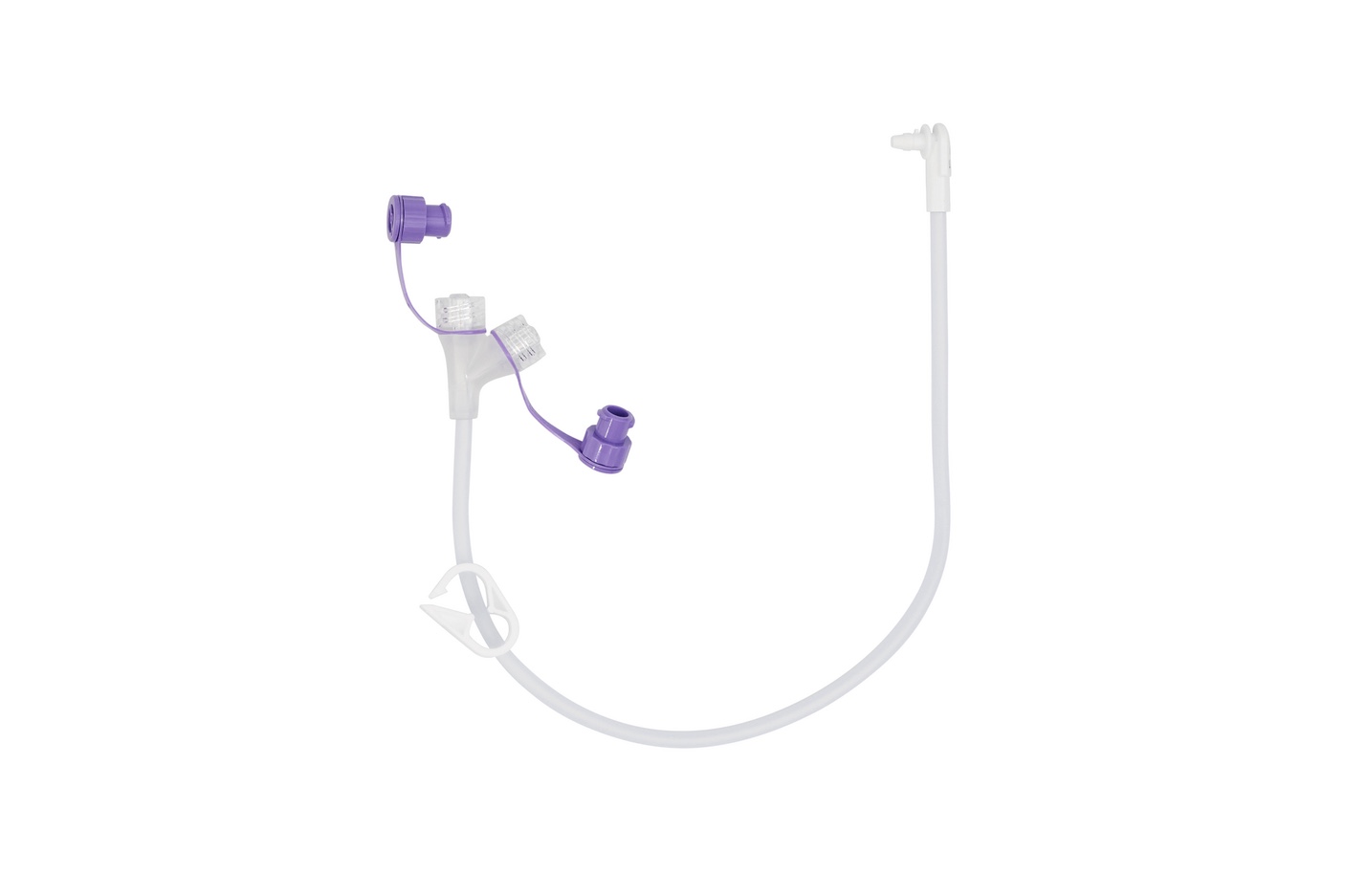
Continuous extension set
This is attached most often to the J port of the GJ Tube for continuous feeding over a few hours, usually using a pump. Continuous feeding can be done during the daytime or overnight. The continuous extension set is more commonly used with the GJ Tube.

Bolus extension set
This is used for those who can handle feedings in their stomach or if they need to decompress their stomach. This is attached to the G port of the GJ Tube when a “bolus” feed is needed. A “bolus” feed is used when a certain amount of nutrition is given through the tube over a short period of time, usually about 20 minutes. It travels down the tube using gravity and a syringe. The bolus extension set can also be used to give medicine.
There are many formulas or feeding choices for tube feeding. Your healthcare team will choose what is best for you. A dietitian will work with you to make a feeding plan before you leave the hospital. Your healthcare team should help you find a feeding schedule that fits best into your family routine. This can change as your needs change.
Sometimes you may need extra water to meet daily fluid needs. Just like people drink something along with their meal, you will need some extra water with your nutrition. This is called “extra free water.” Your healthcare team or dietitian will tell you how much extra free water you need. Extra water is often given after medicines, or in between or after feedings.
You will be taught exactly what to do before going home. You will also be given information to take home in case you forget anything. Your healthcare team should tell you who to contact with any questions or concerns.
When does the tube get changed?
When the time comes to change the GJ tube, a new one will be placed during a procedure in the hospital. It cannot be replaced at home. Ask your healthcare team how often to do this.
Videos
MIC* GJ Tube Maintenance and Stoma Care
MIC-KEY* GJ Tube Maintenance and Stoma Care
MIC* GJ Balloon Maintenance
MIC-KEY* GJ Balloon Maintenance
Instructions for Use (IFU) and Patient Guides
Below you will find a link to go to our IFU website to find all of our other patient guides and IFUs. To ensure you always have the most current information regarding your specific product, please visit our Instructions for Use website. When you arrive at the site, scroll down to view the easy-to-follow instructions and have your product part # (the REF# on your product label) ready to enter in the search box. If you don’t know your product part #, then please contact our nurse support team so that they can help you figure this out. Click here for nurse support contact info.
All Patient Guides
IFU Website