



A Former Tubie’s Line to Help and Hope
Zachary Kuleba is thriving.
You can’t tell by looking at him today that he spent the first few years of his life in and out of hospitals, his worried parents trying one solution after another to help their child survive. Diagnosed with Crohn’s disease (an autoimmune disease that causes chronic inflammation in the gut) at only one-and-a-half years old, tube feeding was the thing that allowed Zach to start managing his condition successfully.
It’s hard to blame anyone in a similar situation for wanting to put the experience behind them. But while the fear and uncertainty of those years is gone, Zach—who is now 24 years old and a college graduate–doesn’t want to forget.
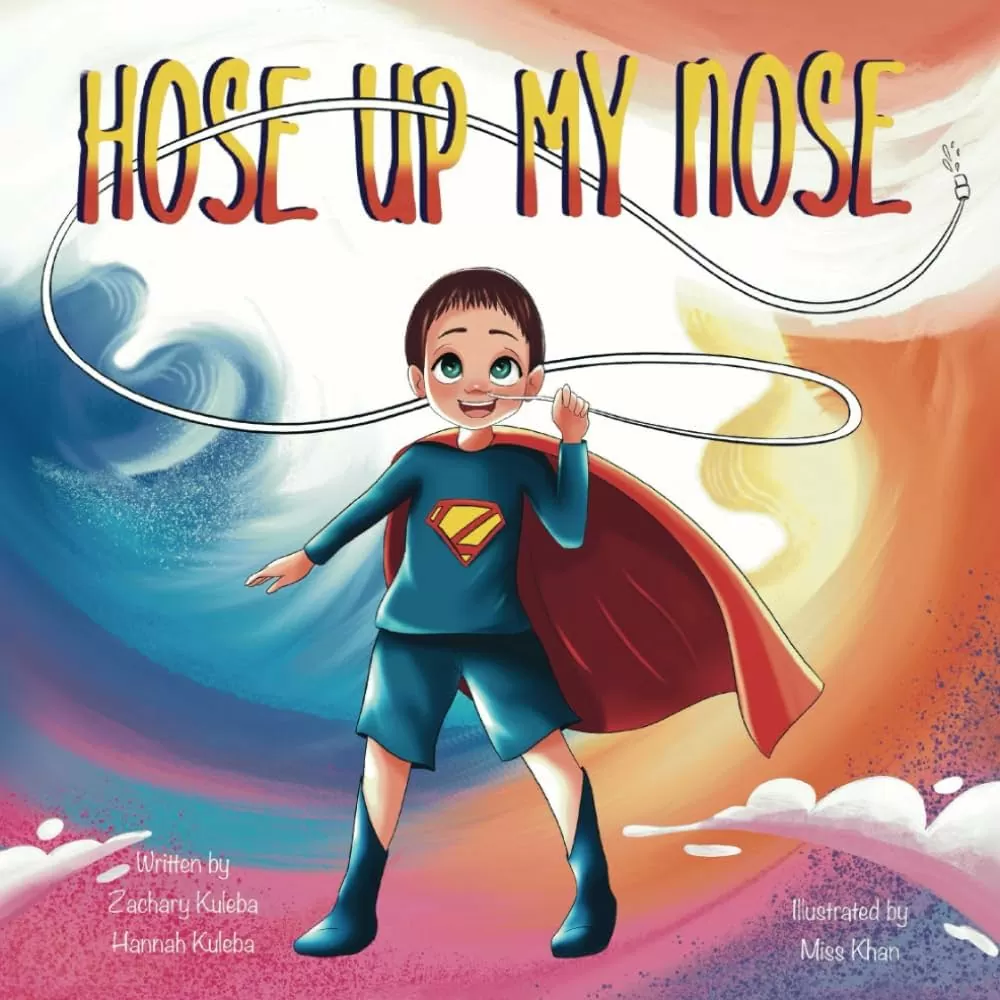
In fact, he and his younger sister, Hannah, decided to share their family’s story in a children’s book called Hose Up My Nose. By starting the conversation in a compassionate way, they hope to reassure kids and families that being different is okay, and that medical treatment doesn’t have to be frightening or isolating.
About those kids, Zach says, “I don’t want someone looking at them and thinking that they’re weird or have something scary going on, because it’s just a part of their life now. Like it was a part of mine.”
A Devastating Diagnosis
Barb Kuleba, Zach’s mom, said he was 10 months old the first time she found blood in his diaper. He had been having issues with food and digestion since birth, but it was a few more months after that first scary incident before they knew what was wrong.
Once it became clear it was Crohn’s, Zach’s doctors gave him medication, but it didn’t help. Neither did the next kind they tried, or the next. Steroid treatment would go on to cause so much pressure to build up in his brain that he needed a spinal tap to relieve it. Much later, Barb would find out he had an allergy to the whole class of medications used to treat Crohn’s at the time.
When a routine check-up showed five-year-old Zach had not grown in a year, his care team said tube feeding was the way to get him the nutrition he needed. It seemed like a last resort to Barb, something to do when all other options were gone. Little did she know it would be the treatment that turned Zach’s life around.
A Line to Better Health
Zach was given a CORFLO* nasogastric (NG) tube. He learned how to set up his feeds and what to do if the alarm went off, so he could get nutrition on sleepovers and vacations.
“He knew how to do everything,” says Barb, “so he could be empowered to go and do things that little boys do, and be normal.”
Soon, Zach would feed for 10 hours at night and still wake up hungry. Letting him eat by mouth during the day didn’t hurt his progress. Typically, people with Crohn’s disease who tube feed only use formula and don’t eat by mouth, because some foods can make the inflammation worse. But since Zach was growing normally and managing symptoms, his doctor said it was okay.
The Family’s All In
From the time he began tube feeding, Barb wanted to make sure of three things: that Zach was always involved in decisions about his care, that he felt supported, and that the family never treated tube feeding as something strange or shameful.
Hannah grew up alongside Zach and his tube feeds. When she was very young, she remembers wanting a feeding tube of her own—a pink one! In third grade, she brought her brother in for show-and-tell. Barb was skeptical about it, but let her go ahead, anyway.
“She educated everybody on it, as little as she was,” Barb says. “‘This is my brother. He has Crohn’s disease.’ It wasn’t a big deal.”
And no one made it a big deal. As Barb recalls, every time a new friend came over to play video games with Zach, “they would knock on the door and say, ‘Zach, what’s that on your face?’” When Zach told them it was medicine, they said, “Okay,” and that was the end of it.
Growing Awareness, Cultivating Empathy
To the Kuleba family, giving back felt as important as getting Zach the right treatment. That meant raising awareness about inflammatory bowel disease, supporting research, and talking openly about the challenges and victories of being a family with a chronically ill child.

It began with an idea from Barb, a “dollar letter” sent by email to friends and family. It features a picture of Zach with his feeding tube and an appeal for donors to give as little as one dollar to IBD research. To her delighted surprise, the dollar letter turned into $18,000 for the hospital’s IBD center.
An amazing one-time result, but Barb wanted to create something long-lasting. In the span of 5-6 weeks, she put together a fundraising 5K walk-run that became an annual event. The Walk for Hope to cure IBD is now in its 15th year and has raised over one million dollars for pediatric research. Although the hospital took over organizing the event a few years ago, all money raised still goes to IBD research.
Her efforts inspired Zach and Hannah to want to give back, too. Both kids participated in research studies. Once, Hannah’s appeals to her school PTA raised $1,500 for the Walk for Hope. Barb remembers Zach coming home from middle school after a presentation about a little boy with diabetes who had to give himself insulin shots.
About the boy, Barb remembers Zach saying, “If he can give himself needles, then I can raise money for him so they can find a cure for his disease, too.” And he did, taking part in the fundraising “sneaker campaign” for the Juvenile Diabetes Research Fund.
The Book: A Long Time in the Making
When Zach was still in elementary school, Barb remembers going through his school papers and seeing a story he wrote, titled “Hose Up My Nose.” It was about his feeding tube. Barb showed it to a friend in the pharmaceutical industry, who told her right away it should be a children’s book. She agreed, but was so caught up in fundraising, family life, and Zach’s health, she tucked it away for later.
Still, seeing how Zach and Hannah helped both kids and parents feel less fearful about IBD treatment and tube feeding, the idea of using a book to reach out was never far from her mind. In 2023, the whole family was ready. Zach wrote and updated his text from all those years ago. Hannah did some editing and added memories of her experiences. Zach’s explanation to his gaming friends, his insistence that he learn to put the tube in by himself—all those true stories went into the book. When they finished, they found an illustrator, and soon Hose Up My Nose was a reality.
Barb remembers sending the manuscript pre-publication to a friend who used to raise funds for the Walk for Hope. To her shock, the friend said her young daughter had a pediatric feeding disorder and would need a feeding tube. Reading the book had eased her worry about making that choice for her child.
“I said, ‘Read this to your daughter,’” Barb said, “’and let her know it’s okay. These things are scary, and you need to know that—you know what? We’ve been there, we’ve done it, we got through it, it’s okay. And you’re going to get through it, too.’”
Once the book came out, Barb got messages from parents with kids of all ages, saying it has opened up conversations about not only tube feeding and IBD but about accepting people for who they are. Not to mention the power of hope.
Zach’s Crohn’s is largely in remission thanks to IV infusions every eight weeks. “I think one of the things that got me through it was just having hope that one day a cure will be found, or at the very least treatments will get better,” he said. “A little bit of hope goes a long way.”
[This article is based on an interview with Zach, Hannah, and Barb Kuleba in May 2024.]
