



Play With a Purpose: The Butterfly Pig

Can pretend medical equipment help children heal?
Well, if the equipment in question is one of the toy medical devices made by a growing company called The Butterfly Pig, the answer is a resounding yes. And they have the numbers to prove it! Earlier this year, The Butterfly Pig—the brainchild of mom and former nurse Mary Jenner—surveyed both healthcare professionals (HCPs) and parents of pediatric patients at 22 hospitals across the globe to better understand how its toys support kids receiving treatment.
The company sent toys to each hospital and asked HCPs and parents to complete surveys both before and after the kids had a chance to interact with toys that corresponded to their medical treatment. The results showed:
- After only one interaction with the toys, respondents rated children’s understanding of their medical procedure 112% higher than before the toys were introduced.
- Respondents rated patient anxiety about the procedure as 40% lower after children had a chance to interact with the toys.
- Patient cooperation went up by 150% after introducing the toys, according to respondents.
“Current education is primarily given to children in the medical setting verbally or by handouts,” Mary Jenner says. “But children learn best by doing or seeing.”
She learned this firsthand long before The Butterfly Pig was an idea, much less the company it is today. As a pediatric oncology nurse, Mary would demonstrate the procedures as much as she could on the patients’ favorite toys and stuffed animals before doing them on the patients themselves.
“And that really made a huge difference in terms of their understanding and cooperation,” she says, noting that kids who might have had to be restrained for a procedure would often sit still after seeing it acted out on a favorite toy. Still, there were limits to what supplies HCPS could safely leave with the dolls. For example, a spare port-a-cath or PICC line might be fine to place in a toy, but a real syringe could present risks if a child were to inject air in one of their lines.
At the time, ideas for better and safer educational tools were circling in Mary’s mind, but it would be many years before she had time to make them a reality.
From Hobby to High Demand
While on maternity leave from her nursing job, Mary had a chance to slow down and think of ways to get better medical education into the hands of the smallest patients. And it just so happened that a parent had asked her if she could make a set of hearing aids for her child’s doll. Mary agreed and made the tiny hearing aids out of clay.
The parent and child were delighted, and word began to get around. Soon more parents were asking for little replicas of their children’s medical devices. Requests poured in, and Mary wanted to fulfill every one of them. But hand-sculpting each piece herself would take up too much time. The solution? Buy a 3D printer, then teach herself CAD software and basic principles of design.
Even with a way to meet the new volume demand, more and more requests poured in—some for replicas of equipment Mary did not feel comfortable trying to design herself. So, she called in reinforcements in the form of her father, who had worked as an engineer. Luckily, when Mary pulled him out of retirement to support the business, he was more than happy to help.
Their respective work experience—Mary’s in the medical field and her dad’s in engineering—still informs the work they do on each piece. “I know how to make [the toys] safe and educational,” Mary says. “He can reference pictures of the real thing and make it look really realistic.”
The Butterfly Pig officially opened as a business in 2020, still run out of Mary’s house. Why “The Butterfly Pig?” The name represents defying expectation and overcoming limitations: if people say something will happen “when pigs fly,” a pig with wings proves it can be done.
Getting the Toys Where They’re Needed Most
The company kept growing, and before she knew it, Mary began getting inquiries that mirrored her purpose in creating The Butterfly Pig in the first place.
“Child life specialists started reaching out, and that’s when we started to get more demand for these… educational and interactive toys,” she says. “Now most of our customers are child life specialists and healthcare providers.”
Mary had pulled in family to help support the business while she ran it part-time, still working as a nurse. With business only picking up, though, she finally left nursing in 2023 to head up the enterprise full-time. It’s now run out of a modestly sized office rather than Mary’s house, and staff includes both of Mary’s parents, her sister-in-law, and a cousin.
“And we just hired our first non-family employee,” she tells us proudly.
No Limits, Infinite Possibilities
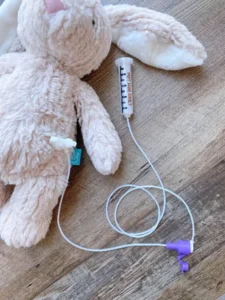
It’s hardly a wonder that The Butterfly Pig was able to conduct such a broad survey study. As of 2024, its toys have been purchased by more than 80 hospitals at home and abroad. Mary has no intention of stopping there, however. She says the company is constantly developing new designs and trying to get them into hospitals where kids can see and use them.
A toy low-profile “button” G-tube is one of its most popular items, but it doesn’t stop there. Kids who tube feed can give their doll or stuffed toy a miniature enteral feeding pump, IV pole, and gravity syringe, among many other types of medical equipment.
A casual scroll through the online store shows the tiny devices placed on a wide variety of comfort toys, including dolls representing a whole rainbow of skin tones and hair types. This was a conscious choice, Mary says. While isolating with her family during the COVID-19 pandemic, she wanted to make sure her daughter saw the immense diversity of humanity in media if she couldn’t yet see it in person. That included movies, books, and the Butterfly Pig website. She directs parents and healthcare providers to companies that make diverse dolls, because it’s just as important for kids to have toys that look like them as it is to have medical devices that look like their own.
While Mary couldn’t have predicted the success of The Butterfly Pig when first sculpting those tiny hearing aids from clay, she sees it as a natural extension of everything she’s passionate about. “I feel like this job really chose me,” she says.
